

Changes approved, go next to City Council
New zoning standards were unanimously approved by the Newcastle Planning Commission at a recent meeting and will be sent to the City Council for their approval or disapproval.
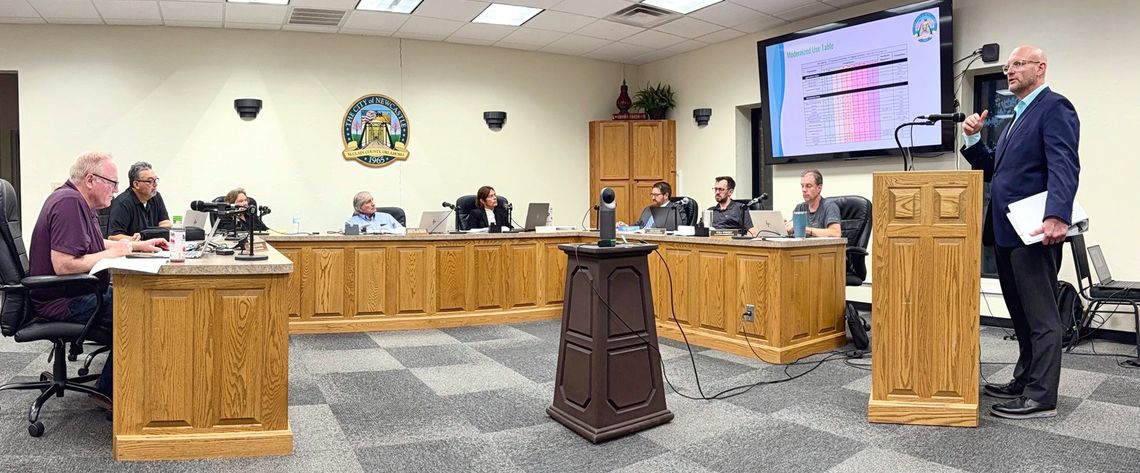
The City of Newcastle has been working the past two years with Freese and Nichols, an engineering, planning and consulting firm, to update the city’s development code. Chad Bunger, an Urban Planner with the Freese and Nichols Tulsa office, was in attendance at the Planning Commission’s September 28 regular meeting to provide an update on the work the firm has been doing.
Bunger said he has been working with city staff to update and modernize the current code. He said the changes are expected to take the community to the next step as it grows and help maintain its character.
Planning Commission Chairman Gordon Harness said, “This is a continuation of what we have, but in a different format. It is more understandable and user friendly. It’s the old basic provisions, just brought forward. It also clears up some things that needed to be clarified.”
Bunger added that the proposed changes made processes in the development code more clear and transparent.
PLANNING: Predictable, transparent process reflects current best practices
He said the approval authority is defined as to who does review and who cites, etc.
“People are able to know all of the procedures and they are able to follow what they describe as a predictable and transparent process,” he said.
Bunger said an update of the development code helps the City to implement the Newcastle 2040 Comprehensive Plan. It reflects current planning and engineering best practices, improves usability for residents, staff and developers, provides predictable development standards, and protects the community’s character while accomodating future growth.
Bunger said the proposed changes to code takes the vision established with the city’s comprehensive plan and identifies barriers, and recommends improvements. The changes include reorganizing into three coordinated ordinances, providing consistency in the chapter organization and numbering, providing more modern formatting with the use of tables, graphics and illustrations, consolidation of development standards, and providing definitions and cross references for easier understanding and access.
Bunger said the old code had limited housing options, outdated land use classifications, and development patterns that no longer reflect current market needs. In response, the code update provides guidelines for expanded housing options including cottage courts, Accessory Dwelling Units (garage units, backyard bungalows, or cottages), townhouses, and tiny homes.
Bunger said the procedures for reviewing applications is better defined and more standardized, and provides approval authority tables, updated appeals and relief procedures, and better administrative review processes.
SOME NOTABLE CHANGES
Of note were better transitions between adjacent land uses. There were changes to code for landscaping and community character for districts that abut each other but are not necessarily compatible. Changes include more screening and required distance between these properties.
Code for neighborhood design was improved, with new standards for lot layout, block design, and street connectivity. Bunger said there is improved access management for neighborhoods to support safer streets and future connectivity.
There are expanded requirements for park land dedication and open spaces, protecting natural features while integrating parks into neighborhood design. Bunger said this encourages development that contributes to the city’s parks and trail network.
Bunger said the infrastructure standards were modernized, providing today’s standards for water, wastewater, storm water and underground utilities.
Sign regulations were also modernized, with updated design standards for signs erected or placed in the city that are attached, detached, incidental, and those that are special and temporary. If approved by the City Council to go into effect, city staff will be able to use either the old development code or the new development code through the end of the year on December 31, 2026. After that, the new development code will go into effect and will solely be used.