

t was June 1968 when I arrived in Washington, D.C., after a year in New Orleans clerking for Fifth Circuit Judge John Minor Wisdom. A new law requiring more government transparency was just going into effect.
I had accepted a job as a Special Assistant to Assistant Attorney General Frank Wozencraft in the Office of Legal Counsel (OLC) in the U.S. Department of Justice (DOJ). While I worked on efforts to advance the confirmation of Abe Fortas to be Chief Justice on the Supreme Court, I was also assigned to work with OLC attorney Warren Belmar, who was putting the finishing touches on a guidance document for agencies about how to implement the new open government law. The executive branch refused to refer to the law as the “Freedom of Information Act”; it had been originally introduced in the 1950s as the “Public Information Act” but was more colorfully renamed in 1965. The DOJ Memorandum, however, was entitled “The Attorney General’s Memorandum on the Public Information Section of the AdministrativeProcedureAct.”Itreliedheavily on the House of Representative’s report on the act – a report that, having largely been drafted in close consultation with the Department of Justice (DOJ), leaned heavily towards restrictive interpretations of the statute, even when they were inconsistent with the language of the new law.
Congressional approval of what eventually became known as the Freedom of Information Act (FOIA) had not been smooth, and in fact it took more than a decade before there would be a law enabling the public to obtain government information.
Widespread secrecy that pervaded the post-war Eisenhower administration not only caused equally widespread consternation on the part of the media, but also caught the attention of members of Congress, most notably John Moss, a California Democrat.
Moss held a series of hearings starting in November 1955,castinganembarrassingspotlight on the Eisenhower administration’s denial of public access to all manner of government records that even included newspaper clippings and agency telephone directories – hardly top secret, or even confidential. Moss heard testimony from 27 agencies on his proposed transparency legislation; all opposed it. Moss envisioned a legal framework that would force the executive branch to disclose most government records when requested by the public. His efforts bore fruit when a bipartisan majority of both the House and Senate in 1966 sent Senate bill 1160 to the White House for the President’s signature.
But the Johnson administration was strongly opposed,claimingitwouldposeriskstonational security and impinge on the authority of the executive branch to protect confidential information.
That opposition marked the beginning of decades of consistent opposition by subsequent administrations to any amendments to clarify and strengthen that statute. The Department of Justice pressed the argument that the law unconstitutionally constrained the authority of the executive branch while also claiming that the law was “lamentably drafted” and that the exemptions to required disclosure were “vague and inadequate.” The law, the DOJ said, attempted to “apply simple word-formulas” to records where individual privacy or the public interest was at issue. And, DOJ argued, it failed to permit “any exercise of executive discretion,” raising both “difficulties and dangers which are compounded because these formulas are so poorly drafted.”
DOJ’s complaint that the text of the FOIA was “vague and inadequate” was not far off the mark. Professor Kenneth Culp Davis, in his seminal 1967 Chicago Law Review article on the FOIA, asserted that the legislative history of that act was so confusing and inconsistent that you had to look to the statutory language to glean its meaning.
President Johnson was prepared to veto the legislation, following the advice of every federal agency that weighed in. At the same time, despite uniform agency hostility toward the new law, the president was being buffeted by criticism over his handling of the War in Vietnam. At the last minute, Johnson followed the advice from Bill Moyers, his press secretary, and signed the bill. He issued a laudable signing statement instead of the veto statement he also had in hand.
Although Johnson voiced concern over many of the requirements of the act, his statement, issued nearly 60 years ago on July 4, 1966, from his ranch in Texas, extolled the new law with ringing praise: This legislation springs from one of our most essential principles: A democracy works best when the people have all the information that the security of the Nation permits. No one should be able to pull curtains of secrecy around decisions which can be revealed without injury to the public interest.
Once the law took effect, OLC assumed responsibility for advising federal agencies about what they had to do to comply. That’s where I first encountered the challenge of implementation by hostile agencies.
After the statute took effect, the Veterans Administration asked OLC how it could deny a public records request from Consumers Union for hearing aid test data. The agency wanted to withhold the data, fearing that hearing aid manufacturers would stop providing free samples for testing if low test results became available to the public.
OLC advised the VA that it was required to disclose the data, but the VA ignored our advice. Consumers Union sued, and in one of the first judicial opinions interpreting the act, a federal district court ordered disclosure. The case went up to the U.S. Second Circuit Court of Appeals but was dismissed in 1971 as moot after the government conceded during oral argument that the requested test data did not fall under any exemptions of the FOIA.
In 1969, after the arrival of the Nixon administration, I left OLC to join the staff of Sen. Edward Kennedy’s Judiciary Subcommittee on Administrative Practice and Procedure. Since I had some experience (not yet expertise) with the FOIA, I was assigned to take on that subject, which was under our subcommittee’s jurisdiction. Both the lack of clarity of some of the law’s provisions and the recalcitrance of federal agencies to follow its mandates led to the 1974 FOIA Amendments (that I had a hand in drafting), which significantly strengthened the law. It also marked the beginning of four decades of legislation that included the 1996 EFOIA, the OPEN Government Act of 2007, and the 2016 FOIA Improvements Act – all of which, in most respects, strengthened the Freedom of Information Act.
Nonetheless, problems remain. And they are growing.
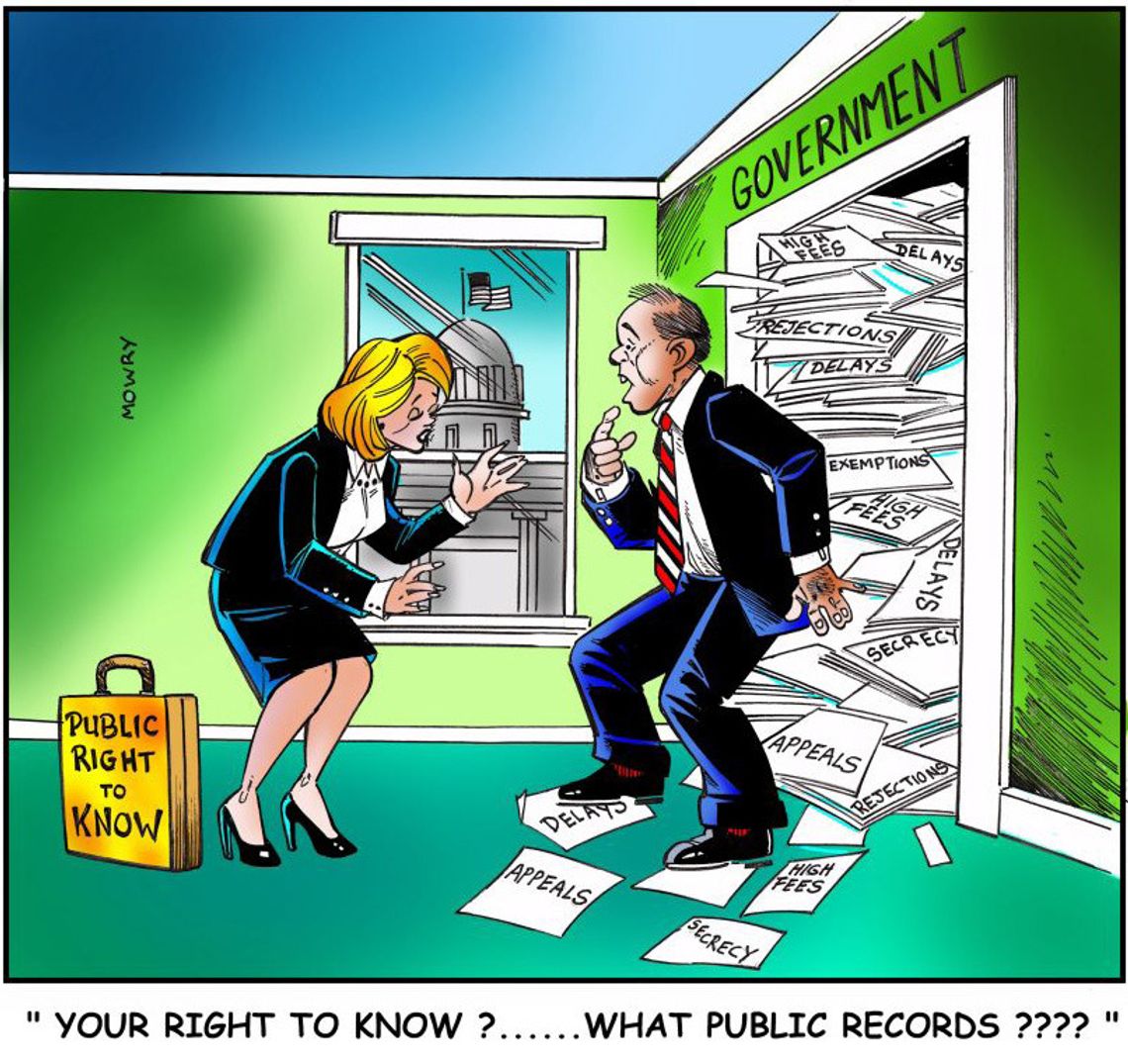
The act’s deadlines for responses to requests are nearly dead letters, with many agencies having record-high backlogs. Exemptions are being stretched beyond reasonable limits to deny access, and fees appear in many instances to be used – as they were before the 1974 Amendments – to impede release of information. Websites are being taken down and important data no longer collected and made proactively available. The U.S. has withdrawn from the Open Government Partnership and has discontinued internal initiatives to improve transparency, while drastically reducing staff in agency FOIA offices.
Congress created and strengthened the FOIA, and it did so historically on a bipartisan basis. It will be up to Congress to step in to ensure that the public’s right to know does not become just an illusion.
(EDITOR’S NOTE: Thomas M. Susman is the American Bar Association’s Strategic Advisor for Global Programs and Governmental Affairs and a member of the National Freedom of Information Coalition board.)